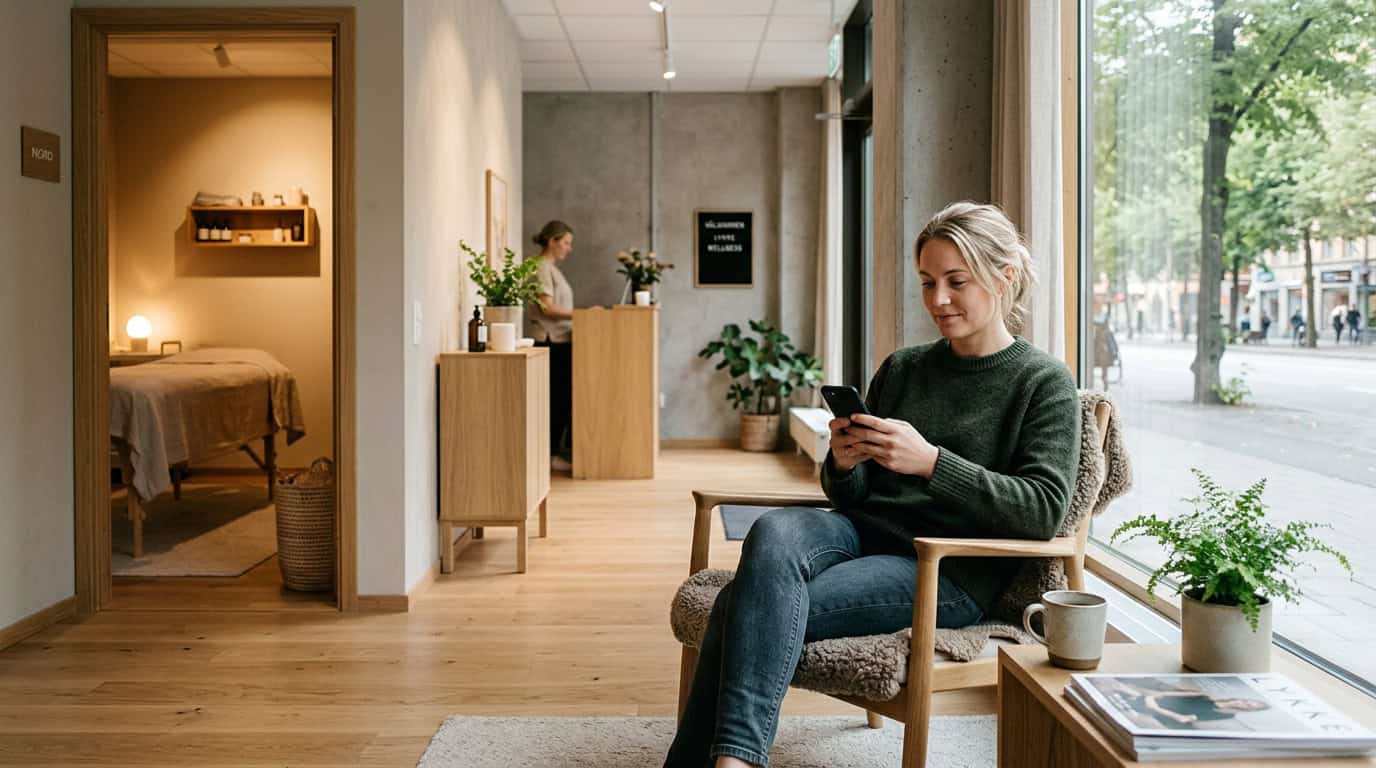
You have added a “Book online” button to your website. Good start.
But when the customer clicks, something feels off. The booking opens on a different address, the design does not match your site, and your treatments do not show up in Google because the text is hidden inside a widget.
This is more common than you would think. Most people put all their energy into choosing the right booking system, and almost no one thinks about how it should connect to the website. Yet it is often the connection that decides how it works in practice, for your visibility, your brand and your GDPR handling. For clinics and local service businesses, that connection affects how many people find you, how many actually book, and how safely customer data is handled.
This guide covers both sides. We will start with the strongest reason to have a booking system on your website in the first place.
Fewer no-shows is the best reason to start
No-shows cost money. An empty chair in the middle of the day can never be earned back. And the problem is bigger than most people realise. In Sweden’s Västra Götaland region, around 160,000 booked hospital visits were missed during 2018, which the region estimated to cost well over half a billion kronor. (Läkartidningen)
This is where automatic SMS reminders make a real difference. At the gynaecology clinic in Kungälv, the number of missed visits dropped by 35 percent after they introduced SMS reminders and let patients book and cancel themselves. (Läkartidningen)
And these are not just isolated examples. A systematic review of 29 studies found that automatic reminders cut no-shows by around 29 percent of the baseline on average, and manual reminders by around 39 percent. (Hasvold & Wootton, J Telemed Telecare 2011) The effect holds whether the visit is a doctor’s appointment or a session with a physiotherapist.
One thing to be honest about: booking vendors love to quote figures like “98 percent open rate” for SMS. That kind of claim comes from the vendors’ own marketing, not from independent research. That reminders reduce no-shows is well documented. The exact open rate is not.
How to connect a booking system to your website
Here is the part almost no one explains. There are four ways to make a booking system work together with your website, and they differ more than you would think.
A plain link. You add a button that sends the visitor on to the vendor’s booking page. The simplest of all. The downside is that the customer leaves your website entirely.
An iframe. Picture a rectangular hole in your page where the vendor’s booking page is displayed inside your own. It looks more integrated, but has technical problems we will get to shortly.
A JavaScript widget. A small script that loads the booking directly onto the page. Smoother than a plain iframe, and most modern systems offer it. BokaMera, SimplyBook.me and Boka.se all have some version of this.
An API integration. Here you build a booking function of your own on your page that pulls available times via the vendor’s API. The most work, but full control over appearance, content and how everything ties in with your other systems.
The further down the list, the more control you get, and the more work it takes. For many small businesses, a widget is more than enough. But there is a problem with widgets and iframes that hits clinics and local businesses especially hard.
Why an iframe or widget can cost you visibility in Google
This is the part most guides skip, and it is often the one that costs the most.
Content loaded via an iframe or JavaScript widget can be harder for search engines to interpret, index and attribute to the right page. Treatment names and prices that exist only inside the widget risk not being counted as part of your page. That is why important treatments, prices and service text should also appear as plain text directly on the page.
For a physiotherapist or dentist who lives on local search, this is a real problem. If someone searches for “back treatment physiotherapist Kungsbacka” and your treatment names sit only inside a widget, they effectively do not exist for Google. The same principle applies to AI search, such as Google AI Overviews and ChatGPT. They work best when important information sits clearly in the page’s visible text, with headings, service names, prices and local signals.
Iframes also have problems of their own. They are hard to make responsive on mobile, and they create trouble for screen readers and keyboard navigation. The user does not always know whether it is the frame or the page that is scrolling. That is one of the reasons to be careful about putting important functionality inside an iframe.
Do you want your treatments and prices to show up in search results? Then that content needs to sit as real text on the page, not hidden in a script. It is one of the strongest reasons to consider a more bespoke solution, but more on that further down.
Which system suits your business?
There is no one solution that fits everyone. It depends on what you do. Here is honest guidance based on what different kinds of businesses actually need. Since clinics have the strictest requirements, we will start there.
A care clinic that needs medical records, BankID and Swedish data storage. If you handle patient data and want to connect to 1177 (Sweden’s national patient portal), this is critical. Kaddio is approved by Inera to deliver patient data to 1177 and offers login with BankID and Swedish data storage. MERIDIQ and Webdoc are built around the Swedish Patient Data Act. TimeCenter connects to the Swedish records system Venturi, so bookings are transferred automatically.
A regular service business that wants to get going quickly. Salon, masseur, consultant, workshop. Here the general systems work well. BokaMera (Swedish, plans from SEK 249/month excluding VAT according to their support page, retrieved June 2026) is a broad option with an open API. TimeCenter (from SEK 279/month with a twelve-month commitment, retrieved June 2026) has servers in Sweden and includes SMS reminders. Cliento emphasises that you own the customer relationship yourself and act as the data controller.
A business that wants visibility on a marketplace. Bokadirekt is strongest if you want to reach customers through their own platform within beauty and health. SMS is an add-on at around SEK 1 plus VAT per message (retrieved June 2026). You gain exposure, but trade away some control over your own brand.
International or budget-focused without Swedish healthcare requirements. SimplyBook.me (plans in USD, from USD 13.9/month according to their pricing page, retrieved June 2026) has a complete API and a modern widget. But it lacks Swedish BankID, medical records and a 1177 connection, which makes it unsuitable for care clinics.
A note on prices: in several cases the figures above come from the vendors’ own pages with a date noted, but some are based on comparison sites. Prices change often, so always check directly with the vendor before you decide.
GDPR and medical records, what you cannot afford to miss
This is the part almost no competitor dares to touch, and where you as a clinic carry a real legal risk.
When you use a booking system, you are the data controller, and the vendor is your data processor. That requires a data processing agreement between you. For healthcare providers, the Swedish Authority for Privacy Protection (IMY) is clear: if there is a data processor, there must also be a data processing agreement, and a company that supplies you with a records system or cloud services counts as exactly that kind of processor. (IMY) If the agreement is missing, you have a clear GDPR problem, especially if the system handles customer data, health data or booking history.
For clinics there is more. If the system handles patient data, it must comply with the Swedish Patient Data Act, and you should make sure data is stored within the EU, preferably in Sweden. For SMS reminders, you need to make sure you have a legal basis, clear information to the patient, and that the message does not contain more sensitive information than necessary. A reminder should therefore not reveal what the visit is about.
This is not red tape for its own sake. It is the difference between a system you can trust and one that can become an expensive story if something goes wrong.
When it pays off to build a bespoke solution
For most small service businesses, a standard widget works perfectly well. You save money, get going quickly and never have to think about the code. It is a perfectly reasonable choice.
But sometimes it pays off to go further and build your own connection via API and integrations. This mainly comes down to three situations. When your treatments and prices have to show up in Google and AI search, and therefore need to sit as real, indexable text. When the brand is business-critical and the booking has to look and feel exactly like the rest of the website. And when the booking needs to be tied to a records system, BankID or Swish in a way that off-the-shelf widgets cannot manage.
In those situations a standard widget stops being enough. That is when a bespoke integration becomes an investment that pays for itself, both in visibility and in control. Where the line falls depends entirely on your business, and that is exactly the judgement we make together with our clients.
Frequently asked questions
Can I have booking directly on my own website without sending the customer elsewhere?
Yes. With a JavaScript widget or an API integration, the booking happens directly on your page, without the customer leaving your address. A plain link, on the other hand, sends the visitor on to the vendor’s page.
Will my treatments and prices show up in Google if I use a widget?
Not necessarily. Content loaded via a widget or iframe can be harder for Google and AI tools to read and attribute to your page. If you want to be sure that treatments and prices show up in search, they should appear as plain text directly on the page.
Do I need a data processing agreement with my booking system?
Yes. When the vendor handles personal data on your behalf, a data processing agreement is required. If you handle patient data as a healthcare provider, it is especially important, and additional requirements under the Swedish Patient Data Act also apply.
Do SMS reminders really reduce no-shows?
Yes, it is well documented. Swedish clinics have reported around 35 percent fewer missed visits, and a systematic research review shows reductions of around 29 to 39 percent. The effect is clear regardless of industry.
Not sure how your booking is connected?
A booking system is not hard to paste in. But getting it to show up in Google, look like your website and handle customer data the right way, that is another matter.
Want to know whether your booking system is helping or hurting your visibility? We can look at how the booking is connected, whether your treatments can be indexed, and whether the solution holds up from a GDPR standpoint. Get in touch and we will go through what suits your business.